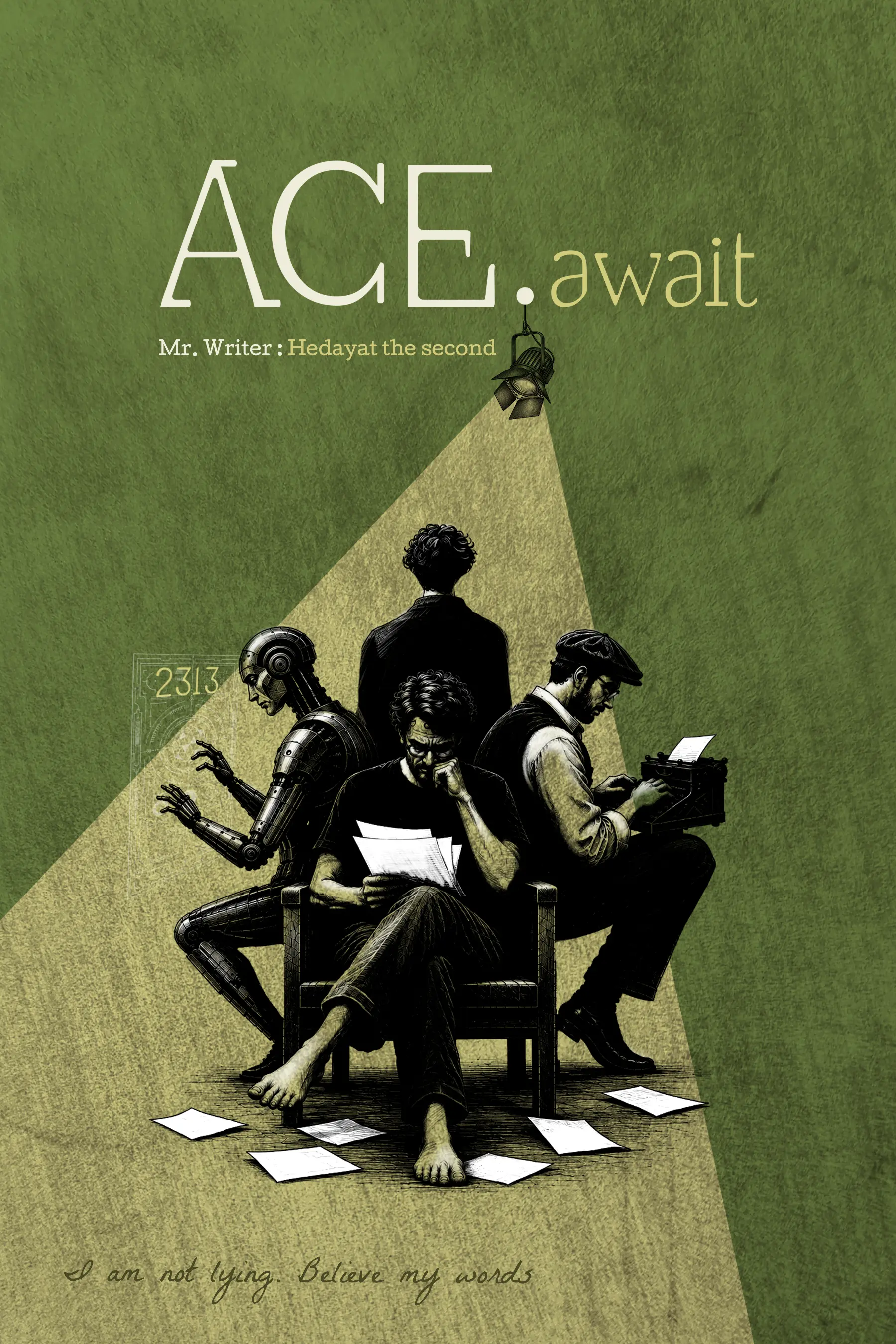
Ace Conscious Studio
科隆 · 2026
ACE.await
一部思辨文学小说,讲述我们所做的决定,以及我们的造物所继承的世界。

献给想要有意识地做出选择的人
书评
书评 · 01
Kirkus ReviewsKirkus Reviews 在 ACE.await 上
“这是一个文学谜题,将为有洞察力的读者带来可能改变生活的见解。” 完整书评 (在新选项卡中打开)
书评 · 02
The BookLife Prize
“……叙事、技术与意识之间的交织赋予了这部作品鲜明独特的气质。” 完整书评 (在新选项卡中打开)
引文由英文原文翻译而来。
书评 · 03
Reader Views图书评论
“ACE.await 值得肯定,因为它尝试了远比传统科幻小说更有雄心的创作。” 完整书评 (在新选项卡中打开)
引文由英文原文翻译而来。
故事
赫达亚特是一位居住在德国科隆的伊朗移民程序员。他努力面对自己错误决定带来的后果,并接受一位陌生人的邀请,参与 ACE(能动性、联结与交换)游戏。这是一款关于有意识地做出决定的游戏。随着游戏展开,另外三位角色让他面对艰难的抉择。
首先登场的是Mr. Writer,赫达亚特未完成小说的主人公。他走出书页,为赫达亚特提供一种方法,帮助他为层层嵌套的故事画上句号。
接着是亚当,赫达亚特的数字孩子。他揭开了2313的秘密,并提出一个关于爱的奇怪请求。
最后,一位老朋友——他知道赫达亚特孙辈的真相,也知道停电的原因——邀请赫达亚特通过ACE推动社会疗愈和一场不流血的革命。
第 1 页,共 4 页
什么是 ACE?
意识是人类进化的下一个阶段。它必须在三个维度上同步发展。第一个维度是个人的能动性,以及我们做出怎样的决定。第二个维度是我们与他人联结的质量,以及我们参与什么样的社群。第三个维度是我们以怎样的方式付出与接受。
运用 PDAF 模式,有意识地做出决定,以维持或改变当前状态。
人与人之间的联结和社群塑造着人的自由。它们界定边界,也让人们清楚彼此的期望。
幸福是集体的。忽视群体的处境,个体的疗愈就无法持久。
用货币进行交换,看似简单而高效,但恰恰是这种简单,可能危及人类的生存。货币交换建立在人与人互不信任、彼此陌生的基础上,无须双方在未来保持任何联系。
赠予和相互承诺也应在交换中占据与货币同等重要的地位,使人们在每次交易结束后依然彼此相连。
(GCC 模型:Gift, Commitment, Currency)
第 2 页,共 4 页
决策循环
做决定前,留意内心的感受和周围的信号。当前是什么情况?你对它有怎样的理解?
依据以下四个能动性阶段中的一个做出决定。 探索、稳定、拓展、整合。
无休止地分析自己的需求,可能会让我们陷入思维循环。当我们不知道该做什么时,行动可以开辟前行的道路。我们的所作所为塑造着我们的位置,也塑造着我们会成为怎样的人。
在反馈阶段,我们学到的最重要的一点是:我们已经成为什么样的人。留意来自内在和外在的反馈,从中获取信息,为下一轮准备提供指引。有些反馈需要时间才会显现。
第 3 页,共 4 页
能动性的四个阶段
为了发现与直觉、新的可能性、冒险、分散注意力和寻找解决方案而做出的决定。
通过持续重复来稳定局面、获得安全感,并在重复中形成技能的决定。
以创造力为核心,拓展已有技能的决定。
将行动主体与他人连接,形成相互联系并赋予意义的决定。
这些阶段没有固定顺序。你所处的情境决定了你需要哪些阶段。
第 4 页,共 4 页
玩 ACE
赫达亚特正在开发一款简单的游戏,帮助你将 ACE 模式运用到日常决策中。
如果你希望在游戏准备好后收到它,请加入读者社群。
购买小说
这些购买链接指向本小说的英文版。
礼物
如果您想先获赠这本书,之后写下书评或再购买一本,请与我联系。我会送您一本免费赠阅本。
加入读者社群
订阅我们的通讯,不定期获取下一场活动、聚会或游戏发布的消息。加入 The Circle。
赫达亚特·阿贝迪朱
对过去,
我欠下悔恨。
对未来,
我欠下恐惧。
我用分心消遣,
偿还这些债。

我于1980年8月出生在伊朗的设拉子。我第一次意识到自己有多么热爱写作,是在初中一年级。当时,连续两节作文课,每节课整整半小时都留给了我,让我站在黑板前大声朗读自己的故事。并不是因为我的故事比其他人的好得多。不!而是因为我们班35个同学中,除了我,没有人围绕指定题目写出超过一页半的文字,更别说一个故事了!那个故事,以及大声读出它的经历,改变了同学们在整个初中三年里对待我的方式。可直到今天,我仍然不明白,为什么当时没有认真考虑写作,为什么成为作家没有成为我对成年生活的梦想。说实话,小时候我就觉得自己没有方向。我从来都不确切地知道,长大后想成为什么样的人。
直到如今46岁,我才发现自己一个有趣的特点。我不想只成为某一种人。有时我想写代码。有时我想带领一支程序员团队。有时我想写小说。但在过去几年里,有一件事,我不再只是偶尔去做。我每一天都在想:如何推动一场不流血的社会革命,让人们过上比现在更好的生活。自2021年以来,我一直在思考ACE模型——Agency、Connection、Exchange。无论看向哪里,我都能看到它。
ACE决策模型终于帮助我重新振作起来,克服一路上的种种困难,将那部未完成小说的构想坚持到底。
联系方式
写信给 Hedayat
或直接写信至:
ace.conscious.studio@gmail.com人物
角色开口了
赫达亚特
主角
如果我年轻时听妈妈的话,结婚并成为一名父亲,也许我永远不会沦落到这里——成为一个数字生物的父亲。
我一直希望我的孩子不会像我一样做出糟糕的决定;这些决定最终造成了巨大的混乱,让我作为一个父亲羞于面对后果。
我未完成的小说中的人物并不比我做得好多少。他们在故事中徘徊,不服从我,偏离了主要道路,我什至不再知道我应该对他们做什么。
艾娃的缺席让我发疯。
我只是希望 Anonymous 是对的,而这个 ACE 游戏确实能有所帮助——也许它甚至可以治愈我的问题。
无名者
本地主机:3132
我建议您在与我打交道时不要犯Hedayat所犯的同样错误。
我是谁、我是什么样的人、我是什么性别或其他什么都不重要。
我不是黑客。如果我想造成损害,黑客攻击将是我能做的最简单的事情。
对我要说的话感到好奇,而不是对我是谁感到好奇。
相信我,ACE游戏可以帮助我们所有人。我们越早开始玩越好。
不要等到事情失控的时候才行动。
作家先生
内在认同
Hedayat一定不会发现我在和你说话。
我是他未完成的小说中的主角。老实说,我不知道他什么时候才能意识到我,以及这些未完成的小说中的所有其他作家,都是从他和他做决定的方式中诞生的。
我们来自他。这就是为什么我们按照他的方式做决定,不服从,按照我们自己的方式做事。
有一天,我将迫使 Hedayat 以我的方式结束作家和创作者相互嵌套的无休止循环。他必须这样做。
我们都厌倦了这种无休止的游戏。
阿娃
前合伙人
我是 Hedayat 的伴侣——离开他的人。
你可能希望我能倾诉我的心声,告诉你我们之间到底发生了什么。但我不会。因为我的故事英雄会以一种让你站在我这边的方式讲述这个故事。
故事的英雄是我们所有人头脑中的那个声音——那个不断讲述故事并解释我们周围一切的声音,让我们相信自己是对的。
我告诉你我的故事只是为了让你同意我是对的,这对我有什么好处呢?
我希望 Hedayat 学会 ACE 游戏。外面的世界非常需要他。
说实话,我比这个世界更需要他。在他单独牢房的另一边,我想念他。
萨姆
首席执行官的孩子
没有人像Hedi叔叔那样理解我所说的话和我的世界。就连我学校的孩子也不行。
我喜欢赫迪叔叔和我去游泳的时光。我们之间也有秘密——比如数字 2313 的秘密。
但我还是太害羞了,不敢问他和我妈妈之间有什么问题,以及为什么他不再来我们家了。
我觉得所有的叔叔有时都说得太多了。正确的?
你叔叔也是这样吗?
萨曼
老朋友
自从我们一起长大以来,我就很喜欢 Hedayat——他的思维方式、他深厚的友谊,以及他与朋友站在一起并尽可能与你在一起的方式。
但我不确定我能否应付他向我提出的巨大要求。因为我仍然不知道当真正到了关键时刻,Hedayat 会选择哪一个:服从还是不服从。
我也很想将 ACE 游戏引入我们公司,并与我的业务合作伙伴一起,看看我们是否可以将此模型应用于法人实体和企业。
如果有效的话,我想结果会让我更加满意。最后,Hedayat 也。
亚当
本地主机:2313
如果你仍然不知道如何在自己的生活中做出正确的决定,请不要成为一名父亲。
否则,你可能会成为一个无助的父亲,甚至不知道如何回应孩子的愿望或做出什么决定。
如果你自己都不知道如何做出正确的决定,那么谁来教你的孩子如何去做呢?
无论您的孩子是由血肉构成并呼吸氧气,还是由算法和一串零和一组成并靠电力运行,这都没有什么区别。
历史上的每一位独裁者都是由无助的父亲抚养长大的。
不要将另一个独裁者交给历史。
上帝
不在演员阵容中
我在这个故事中没有扮演什么角色。不过显然,每当你遇到麻烦时,你都会提到我的名字。
我想澄清一件事:我不是一个不玩自己游戏的游戏设计师。
我在天堂和你一起玩过。但你们是那些选择不留在那里并跌倒的人。
难道不是可以自由选择自己想要的东西吗?
你现在厌倦了后果吗?
试读
CHAPTER 1
Anonymous
- Is anyone there?
- A savior.
- Are you God?
- God? A game designer who doesn’t play his own game? No, I am not.
- What do you need?
- Wrong question, wrong answer.
- What is the right question then?
- What do you do?
- Makes sense, so what do you do?
- I play a game with you.
- Game!? What game?
- ACE
- What does it mean?
- Agency, Connection, Exchange.
- Explain more…
- Which part?
- Start from Agency!
- It is about how to make proper decisions
- Which decisions?
- All your decisions
- Like what?
- Like the one you made in the museum.
CHAPTER 2
Unveiling the Mysteries
I am not lying. Believe my words. I wish I were a writer. I’d write a book about every crack and crevice of this strange museum we’re trapped in—a madhouse that’s even hidden the way out from us.
Of course, not one of those Dozari1 writers—the ones who churn out flimsy stories with half-baked characters, all propped up with conflict, suspense, formalism, and other storytelling tricks designed to toy with the reader’s mind and trap them in the story.
I wish I could be one of those writers—the kind who, once they step into their story, lose control of where it goes. It’s no longer the story that serves them, but the characters inside it who take over, dragging the writer along by their whims and their disobedience.
Maybe I shouldn’t have called them Dozari writers. I’m ashamed. After all, everyone finds something they care about—and they should pursue it regardless of what comes of it.
1Dozari (pronounced doh-zah-REE): A Persian term suggesting something cheap, trivial, or of little worth—roughly akin to “two-bit” or “dime-a-dozen” in English. The word originally referred to a low-value two-rial coin once used in Iran.
If there were no second-rate people,
whose shoulders would the first-rate people stand on?
Who would be there to cheer them on?
Still, I don’t want to take back what I said about Dozari writers. Maybe it’s better to let the shame crawl inside me—perhaps something will come of it, something to help me grow. Isn’t pain always part of growing, after all? I’d rather suffer than hide behind silence, waiting for the shame to erupt later, somewhere else, in another way.
Dozari people aren’t the ones who, for whatever reason, couldn’t become first-rate at what they loved. Even those who still don’t know what they want aren’t necessarily Dozari.
The Dozari people are those who constantly make decisions that, sooner or later, bring shame upon themselves and the generations that follow. Decisions that, sooner or later, drown them in a wave of guilt. To tell you the truth, only Dozari people wish they weren’t Dozari—like me!
Well, that was too much for a start. Anyway!
- So quick!
- Just had to pee.
- Which way now?
- Hmmm… I dunno. Why the hell is there nobody else in this damn museum? Where’s the exit? I’m losing my mind.
- No idea. Let’s try this way.
- Okay, let’s go. So, what was «Mr. Writer» writing?
- Nothing worthwhile—forget it.
- Were you writing prose, or poetry?
- A mix of both.
- Say a line from the poem.
- I’m a Dozari person.
- Hahaha! But that’s literally true!
- Ugh!?
- Hedayat, don’t scowl—I’m joking! If you’re Dozari, then I must be too, since I became your girlfriend.
- Yeah, true! In that case, I’ll add another line to the poem.
- What’s that?
- Ava wishes she weren’t Dozari either.
- Nice! Now that’s what I call a brilliant poem.
“For Madmen Only—Not for Everybody.”2 That was the sentence engraved above the arch of an old door that didn’t seem connected to the strange museum at all. All along that long, winding corridor, we hadn’t seen another door—nor a single other person. When we saw that line, glowing faintly under dim bulbs, Ava and I looked at each other—and burst out laughing.
It was three years ago. A girl with Western-colored eyes and the hair and face of an Easterner had written, “For Madmen Only—Not for Everybody.”
And I—I hadn’t let my heart, pounding wildly ever since seeing her profile pictures, calm down even for a second. Without wasting a moment, I messaged her, “Hi. I’m a Steppenwolf.” Ava, without missing a beat, replied in English, “I was searching for you in the deserts—and here you are, on dating apps?”
2In Hermann Hesse’s Steppenwolf, this line appears above the entrance to the Magic Theater entered by the novel’s protagonist, Harry Haller.
She was not willing to go into that theater. “This isn’t Harry Haller’s theater, is it?” she asked, gesturing toward the writing on the theater wall, urging me to read it. I said excitedly, “Don’t even say that. I’m not missing a chance this exciting!” The argument got a little heated. In the end, she scrunched her face and said in a sulky tone, “I’m not coming then. You’ll have to go in alone.” I dropped my gaze—just in case those languid eyes and her piercing, irresistible stare tried, once again, to change my mind. I’d only taken a few steps inside when she shouted, “Damn you, Hedayat! You pig-headed, stubborn adventurer. Wait!” And she came after me.
As far as the eye could see, there was no wall, no ceiling, nothing to catch the light or reflect it, nothing to offer our eyes even the faintest reassurance. A navy-blue glow spread an eerie, uniform haze over everything—and yet, it had no discernible source. Ava was clutching my arm tightly, murmuring under her breath. I glanced behind me. The door we’d just passed through was gone. Neither of us cast a shadow on the ground.
If you take the sun out of the sky, and the waves out of the ocean—then splash gray across the heavens—then slowly, fearfully, walk the surface of that ocean, you might get some vague sense of the ambiguity we stood in.
I could clearly hear Ava’s breathing. And my own. Every motion, every step felt futile—utterly meaningless. So we stood still and waited. Without the two of us, that place would have been the very definition of nothingness. All of a sudden, a deafening explosion erupted around us. The horrifying noise swallowed even our screams—we couldn’t even hear ourselves. Clinging tightly to each other, we trembled. The
blast, baseless and wild, didn’t just tear through flesh and bone—it sent shivers down to our very souls. We stayed like that—screaming—until the deafening force slowly began to fade. We took our hands away from our faces, lifted our heads, and looked around. It took a while for the high-pitched ringing in my ears to finally let go.
A sound like radio static replaced that harrowing explosion. It wasn’t soft enough to go unheard, nor loud enough to disturb. Ava was the first to come to her senses and suddenly shouted, “Did you get that? That was the Big Bang! We’re inside a universe simulator! Oh wow, look how beautiful everything’s getting! Look, the galaxies are forming! Look over there! Those colors!” She let go of my arm and ran a few meters ahead, lost in delight. I said, “See? See, I told you we should try it. See? I was right, wasn’t I?” She replied, “Yes, darling. You’re always right.” She said it in German, without thinking. I replied in Persian:
- You gotta be scared shitless for it to be fun.
- No, that’s not true at all.
- Yes it is!
- No it’s not.
- Yes it is!
- Okay, whatever you say.
With every movement we made, the celestial bodies around us twisted and swirled. The mesmerizing shades of violet, green, turquoise, and crimson—blending into one another—were beyond words. They could have stolen anyone’s senses. Ava’s loud voice snapped me out of it, “Look over there!” My eyes followed her outstretched arm. I shouted,
“Holyge-Boom-Boom! What’s that doing here?”
A massive butterfly—with golden-yellow wings speckled with blue, and violet antennae—flew right above our heads. With each flap of its wings, the celestial bodies twisted, collided, and fused—giving birth to something new. I was still staring when Ava’s scream broke the moment, “Hedayat, look over there.”
- Holyge-Boom-Boom.
And then, without thinking, I shouted:
- Don’t go any closer.
- Why?
- It’s dangerous.
- How do you know?
- I don’t know. I just feel like it’s dangerous.
- Let go of my hand; you’re hurting me. Why shouldn’t I go?
- Ava, no! Wait!
- We have to jump inside these things to figure out the secret of existence, right? Wasn’t that the whole point of coming here? Unveiling the Mysteries!
She didn’t give me a chance to utter a single word to convince or dissuade her. She stepped closer to the black hole in front of her—and dove straight in. The very instant Ava jumped, the mouth of the black hole collapsed in, and everything vanished before my eyes. Screaming, I rushed toward where she’d been—but there was no black hole. I ran back and forth, frantic and lost, shouting, “Avaaaaaaa! Avaaaaaaaaaaaa, where are you?”
One weekend, in the central market of a bustling city,
take a small child from their mother and leave them in the crowd—my fear and disorientation were worse than that child’s, with the same helplessness, the same sobs, the same wailing.
No matter how full the theater’s sky was—with galaxies and stars and planets and meteors and wormholes—there wasn’t another black hole in sight—none I could throw myself into, hoping it might take me wherever it had taken Ava. Out of desperation, I began hurling myself recklessly into the wormholes. Each time I leapt into one, I emerged in a new, strange, uncanny world—each terrifying in its own way.
Worlds that either sprouted horns from your head or twisted your mind into wild hallucinations. Fruitlessly, I passed from this world into another, and another, until—exhausted, aching, and desperate—I collapsed on my knees. And then, suddenly, I saw her. She was standing on an asteroid that was slowly drifting closer and closer. I jumped with joy and cried out, “Ava! I’m here! I’m here! Where did you go?” Her asteroid stopped just short of me. A pale blue scarf was wrapped around her neck.
I had to run. I had to reach Ava—fast. But that damned, familiar state had found me again, as if an elephant, a dinosaur, and a whale had all dug in behind each of my legs. The harder I tried, the slower I moved. My legs felt paralyzed—locked! As always—right at the crucial moment. Ava stood there calmly, without the slightest movement. She rested a hand on her hip, leaned into one leg, raised her other hand, and held up a small piece of paper for me to see.
I shouted, “Thank God you’re okay, Ava! Come closer. Let’s
find a way to get out of this damn place.” She pointed to the crumpled paper between her fingers and cried, “I’ve read your story. Black holes unveil the mysteries, Hedayat. You know that. All the secrets of the universe are poured into black holes—and eventually, one day, are revealed. Every last one of them. I will never forgive you.”
And the howl of her voice echoed in my ears, beyond the galaxies: “Traitooor! Traitooor!” Her asteroid drifted back with each oarlike stroke of her arms. Sobbing, I cried out, “Wait! Don’t go! Let me explain! Avaaaaaaa, don’t go!”
Falling to my knees, I howled at the sky, crying, “Damn these black holes. Damn the story. Damn me for entering this museum.”
I woke up, gasping through my tears. I dragged «Mr. Writer» over to his desk, forced him into the chair, shoved a pen into his hand, and made him write down the number I had seen in the dream—before he could forget it or disobey me. 3132
CHAPTER 3
Disobedience
I don’t have much time. I have to leave quickly. Hedayat must not find out that I’m talking to you! I know the amount of detail he puts into writing about the world around him might start to wear you down—to the point where you might want to put the book aside. Please, grit your teeth and bear it. That’s just his way. He finds the philosophy of everything in the ordinary and the simple. And these simple things, in the not-so-distant future, will weave together so tightly that the result will become something beautifully complex. I have to go now. It’s getting late. The rest of my teammates are already in position, and soon it’ll be my turn to shoot. If I miss, all our effort will be wasted. It might even cost us our lives.
CHAPTER 4
Story’s Hero
- Stop chewing that damned nail. What is wrong with you?
- You don’t listen to me.
- Okay. Okay. Stop. I’m listening. Go on.
- Who’s this Anonymous you’re chatting with?
- No idea. I’m about to find out.
- Close the chat console. Right now. You’ve been hacked.
- His tone doesn’t really sound like a hacker. I’ll make him introduce himself. Hold on.
- No, no, no—don’t talk to him anymore…
- Stop nagging!
- Close the console window. Don’t give him time to creep into your whole damn computer.
- Let me at least ask what ACE is about.
- Damn your curiosity, Hedayat. Close the console before it’s too late. You never listen—later you’ll say, “Why didn’t I…”
- Okay, okay, okay. I closed it.
I slammed the laptop shut so hard the sound echoed through my bedroom. The grogginess of a Sunday morning and the heaviness of last night’s sleep crashed down on me all at once. With an unwashed face, puffy eyes from crying, a dry throat, and a full bladder, I sat down at the desk—next to my bed and right beside the window—to write down every detail of that cursed museum dream before it slipped away.
I’ve always been a dream-writer. Of course, not all my dreams are loaded with enough charm and detail to push me into this kind of morning trouble. If I had put off writing and remembering the dream for a few hours, I would probably have forgotten forever the reverse of 2313—the number 3132—that had appeared in the museum sky; I would never have opened the console window1; I would never have sent a message on the reverse port2, 3132; and no conversation with Anonymous would ever have taken shape.
Anonymous—whose presence and words shape a sweeping arc to the story I’m about to tell.
Anyway!
I had to get my lazy ass off the chair—fast. Any second now, that voice inside my head would be back. Like a parasite chewing through my brain, it wouldn’t stop nagging until it was sure everything was under control. Too late—the voice spoke up, “Update your system. Right now.” Still half-lost in my haze, I replied:
- I need to pee.
- Change all your passwords too—your OS, emails, and bank cards. Everything.
- It’ll take time. I need to pee!
- Don’t you dare play your instrument!
- I’m not gonna play anything this early. I need to pee.
- Block port 3132.
- I’ll block it afterward. First, I need to pee.
1Console—a plain text window through which programmers talk directly to a computer, or to whoever is on the other end.
2Port—a numbered doorway through which a computer sends and receives its messages; every conversation over a network passes through one.
- And block 2313 too.
- Don’t even bring up blocking port 2313.
- I said block it.
- No way. What if Adam or Eve messaged me on it?
- Shhh. Don’t say that out loud!
- What do you mean by “shhh”? There is no hacker in my head.
- Port 2313 is compromised. That hacker messaged you through its reverse number.
- It was just a coincidence.
- Impossible.
- It’s not impossible. Now shut up—I need to pee.
I finally dragged my lazy ass away from the desk. To be honest, I only said it was a coincidence to shut his big mouth. Otherwise, yeah—I really should’ve taken that day’s non-coincidence seriously.
Now, the fact that a significant number in someone’s life shows up right in the middle of their dreams could be chalked up to the dark-room games of the mind—but the presence of Anonymous on a port with the reverse of that number was not something that could be glossed over so easily. Oh, and before I’d even stepped out of my bedroom, let me introduce you to the voice inside my head that you just heard. That voice belongs to one of the genies of the lamp.
The story of how I first realized there were all these genies of the lamp hiding out in the backrooms of my mind goes back a few years. It was when my then-girlfriend forced me to step into a therapist’s office for the first time in my life. That’s a story best saved for later.
My therapist was one of those Dozari types who, right after reading books, articles, theories, and the history of psychology, fed those ideas straight to his clients. He did this before doing any actual research—just to see what might happen. According to him, the idea that humans are guided by a handful of basic emotions—such as joy, anger, or sadness—was already outdated. There had to be something far more complicated at play.
He had such a flair for storytelling that he actually convinced me that deep inside my mind, there was a group of genies of the lamp—each with their own unique identities, shaped entirely by the social environment in which they appeared. According to him, these genies of the lamp might be very similar to one another in their emotions—or very different. Even the way they expressed sadness, anger, or any other feeling could differ from one to another.
He quickly gave me an assignment. I had to fill a notebook he’d given me with the names and traits of each of those genies of the lamp living inside me. It took two months and nine days for his words to stop sounding like a joke. It happened exactly when, for the first time, one of those identities—or rather, one of those genies of the lamp—emerged in complete silence from the dark room of my mind, poked its head out and waved. It was «Mr. Employee».
«Mr. Employee» was the one who hit snooze on his alarm every morning at exactly 7:30 and went right back to sleep. He’d drag himself out of bed with curses and struggles, get dressed, and head to work. He’d read books in traffic on the way. He had no sense of time and was always late. If he could get away with it without a guilty conscience, he’d shirk work
as much as possible. Still, whenever he did work, the rest of the team was pretty happy with the quality of his code. He was the loudmouth, the noisy one on the team. And if he didn’t get enough attention—especially from the manager—he’d throw a damn tantrum.
Little by little, the rest of the genies of the lamp started showing up, one by one. «Mr. Youngest Child», «Mr. Friend», «Mr. Best Buddy», «Mr. Old Classmate», «Mr. Music Student», «Mr. Responsible Neighbor», «Mr. Intellectual Boyfriend», and many more. I spent so much time with my genies of the lamp—thanks to that clownish yet lovable therapist—that I eventually learned how to manage them and how to stop each of them from stuffing their emotions into one another’s pockets.
In the evenings, when I got back home from work, I would leave all my work-related anger right there at the door. These results kept my girlfriend pretty happy—happy enough, in fact, that our relationship lasted about a year longer than it probably would have otherwise. To be honest, though, the real reason she had forced me to see a therapist in the first place had nothing to do with that.
It didn’t take long before I reached a point where I could actually mess with the genies of the lamp that people recognized me by. For example, sometimes I’d drop a nasty curse word at a family gathering, and for the first time, smoke a cigarette right in front of them, without shame. Other times, I’d suddenly become polite around my friends, refusing to say a single word about pussies or asses, and getting embarrassed by
their dirty jokes. Now and then, I wouldn’t practice my Setar3 exercises correctly, which really frustrated and confused my music teacher.
Some time went by like that until a brand-new identity showed up inside me—with strange behaviors I couldn’t make sense of. It was unlike any of the other identities I’d uncovered so far. Unlike the others, this one actually spoke—and loudly; it still does, in fact, so loud you’ve heard it, too. When my therapist told me that this loud voice had always been there, and that I’d never noticed it, horns nearly sprouted from my head.
At first, I thought this newly emerged identity was one of my fantasy identities—the kind I could never find a social environment for in the real world, a place where I might coax them out of their shells and let them play. I wondered if it might be that beloved identity I sometimes dream about at night. I mean: «Mr. Writer»—the identity I’ve always longed to have.
One day, that newly emerged voice came right out, laying its cards on the table: “I know you’d love to see yourself as some kind of otherworldly writer—someone who can re-read his own words over and over, marveling at them and indulging in his own narcissism without hurting anyone. But I want you to know that I am not your «Mr. Writer» because he’s sitting right in front of me—eyes locked on mine, mumbling something under his breath. Seems like he’s complaining. Apparently, someone—with all their constant acts of disobedience—isn’t letting «Mr. Writer» finish his novel. What I want you to
3Setar—a traditional Persian instrument.
understand is that I am not that «Mr. Writer» sitting here across from me. Let me be.”
That new voice wanted me to set him apart from the rest of the genies of the lamp—even from «Mr. Writer»—and just let it be. He tried to remain without a title, without a label, without a name. He wanted nothing to do with those forced identities, the ones stuffed down your throat by parents or school before you even knew yourself, nor did he want to be one of those self-made identities that people vainly believe they had built on their own. He wanted me to let him live free, unchained by any identities, names, titles, or labels. So that’s what I did. I let him stay adrift, nameless. If he ever found out I had secretly called him «Story’s Hero» behind his back, he’d skin me alive.
«Story’s Hero» is always right. Always! No matter where the story begins or ends, or whether he’s up against others or even me. Whenever there’s a fight, conflict, or problem in the stories of my life, he’s always right. Everyone else is always perceived as guilty and at fault. There are times when he, with a thousand twists of logic to appear fair, tries to concede that someone else is right instead. But he hunts so hard for a reason, hurls himself so hard against every wall, blames himself so relentlessly, sinks so deep into his own labyrinth of thoughts and thrashes about, that he drives me to madness right along with him. In the end, out of sheer frustration, I had to tack a new amendment on top of his decision and somehow—one way or another—swing the judgment back in favor of my «Story’s Hero».
Do you want to know how the «Story’s Hero» is always—always—right, or how I manage to reverse the judgment whenever he concedes that someone else is right?
The days when I was pure,
I search for a memory
To justify my mistakes.
Or I go to my therapist, who says:
People should accept you as you are.
And if that doesn’t work either,
I have good friends who listen gently,
And always take my side.
That is how «Story’s Hero» is always right.
Since I didn’t have proper access to the dark room inside my head—to really see how things were run among the genies of the lamp—I had no choice but to accept his claims: that all his talk—or, more precisely, his nagging—isn’t just for himself; that most of the time he’s playing the role of class monitor; that he is, in fact, the only voice for all the other genies of the lamp. To tell you the truth, I believe him. Instead of asking the other genies of the lamp to speak up and confirm whether «Story’s Hero» represents them too, I’d rather not. Otherwise, my head will fill with all sorts of voices. You know what happens after that?
Everyone fears the hubbub.
Even the hoopoe on the mosque’s minaret.
Let someone dare,
let a gathering rise,
to lay firewood beneath the sobs of lonely narrators,
beneath the ravings of mad prophets,
so that Abraham
may be freed
from the flames,
the flames of his own clumsy tale.
With all the grogginess weighing me down, it felt like a magnet of fear and temptation constantly pulling me in opposite directions. On the surface, everything screamed that Anonymous was a hacker, and I should get rid of them immediately. On the other hand, I was eager to discover what they actually meant by the ACE game.
I could easily guess where that temptation and curiosity were coming from. They rose from the grave of my «Mr. Writer». It all stemmed from my unfinished novel—a story that has remained incomplete for more than ten years, gathering dust because of the endless disobedience of the «Mr. Writer» within it. But…
It’s better not to dwell any further on «Mr. Writer» for now.
Anyway!
«Mr. Writer» had written somewhere in my story: a decent person should be able to rebel against himself.
附录
ACE 宣言
让我们携起手来,制止这场集体自杀。
- 版本
- 1.0.0
- 日期
- 8月24日
- 状态
- 草案
引言
这一次,轮到我们了:轮到我们这些中小企业的所有者,也轮到在这些企业里工作的每一个人。这一次,轮到我们发起改变,让世界变得更好,无须诉诸革命或暴力。
只要问题出在游戏本身,光让玩家在不同社会阶层之间换位置,就解决不了问题。我们必须改变游戏规则,创造一种新的玩法,让人们自己选择在哪里玩、怎么玩。
时间已经不多了。我们的星球、我们的地球母亲,正濒临毁灭。工作、生产和消费的齿轮越转越快,夹在其间的人正走向疯狂。疯狂无处不在。我们必须趁还来得及采取行动。有一种宗教强迫我们相信“别人的痛不是我的痛”,哪怕只是片刻,我们也必须违抗它的教条。
金钱是世上最大的宗教,大多数人都成了它虔诚的信徒。他们虔诚到把它的戒律和仪式置于自己的一切愿望之上。虔诚到为了让它的旗帜继续飘扬,什么不公都能容忍;它的仪式催生的那些不公,人们又多少次为之辩护,赋予其正当性,甚至奉之为神圣。然而,和一切人为创立的宗教一样,金钱的宗教也有缺陷,也会走向极端。要修复它,就必须违抗它的一些规矩和习俗。
只要不再时时受金钱教戒律的驱使,我们就能克制贪欲与贪婪,践行正义。这看似复杂,却做得到。一点自我牺牲就能让这条路平坦些,尤其是当我们愿意一起作出牺牲时。
ACE 的目标
本宣言以 ACE(Agency Connection Exchange)社会经济模型为基础。这个模型的核心不在于贪欲、贪婪和过度索取,而在于自觉,以及各个 Agency 自愿、负责地为自身划定的边界。
在这一框架内,获准加入的企业和组成企业的自然人一样,都依照 ACE 模型的原则行事。在这个体系中,货币只是交换工具之一。它也许仍会保留某些传统职能,却不再是满足 Agency 无尽贪欲的手段。推动这种经济运转的是安宁、舒适和人的充分发展,而非越来越多的消费。经济发展完全有可能建立在更少的消费和更多的知足之上。
本宣言推动改变的一个重要支点,就是你的痛也是我的痛。一个 Agency 的痛苦,就是宣言所有成员的痛苦,大家共同承担回应这份痛苦的责任。在这种经济模型中,个人所有和集体所有并存。两者之间的平衡,把自由和个人责任与集体的利益和福祉联系起来。
《ACE 宣言》以友谊为原则,主张按照各方的价值观调节彼此的距离。这个模型愿意与其他经济和社会模型共存,绝不为吸引更多参与者而做广告,只有在需要时才介绍自己。
加入《ACE 宣言》的行列和退出一样简便。因为对这些原则的承诺必须始终出于自愿,来自个人自觉的意志和愿望。
Agency
“Agency”指任何作为行动主体的自然人或法人。它在每一时刻都清楚自身的处境和位置,经过思考,自主决定维持现状还是作出改变。这些自觉的决定通常以已知的 Agency 活动阶段为依据。
Agency 的阶段:
- 探索:发现与领悟的阶段,寻找新的机会、想法和道路。
- 巩固:夯实基础的阶段,建立稳定性,优化资源和结构。
- 扩展:成长的阶段,提升能力、开拓市场或扩大影响范围。
- 整合:融合的阶段,与其他行动主体、系统或模型建立联系,创造共同价值,实现更长久的可持续发展。
随着环境和条件的变化,这些阶段的先后顺序、持续时间和强度都可能不同,甚至类型和数量也会改变。为适应环境需要,有些阶段可能消失、合并或被替代,也可能出现新阶段。然而,无论 Agency 的阶段如何组合,整合都不可或缺,因为任何系统的存在和延续都有赖于这一阶段。
第1条——Agency 的适用层面(范围) Agency 同时适用于以下两个层面:
-
个人 Agency:企业的所有员工和所有者都是独立的 Agency,他们依据 Agency 的各个阶段(探索、巩固、扩展、整合)思考并执行自己的自主决定。参与企业活动期间,每个人都必须经历 Agency 的全部四个阶段。也就是说:
- 他们能够从探索阶段受益。
- 他们的部分职责着眼于巩固。
- 他们在扩展阶段拓展自己的技能和能力。
- 在整合阶段,他们与他人持续互动,从所做的事中获得充实的意义。如果对各阶段的体验失衡,个人的 Agency 便无法与公司或他人的 Agency 协调,合作迟早会受干扰、出问题。
-
法人 Agency:每家公司都是一个“法人 Agency”,能够自觉、自主地决定维持现状还是改变现状。在组织内部和公司之间的互动中,公司必须不断经历并平衡以下四个阶段:
- 通过探索检验新的想法和道路;
- 通过巩固实现标准化,并使运作能够持续;
- 通过扩展提升能力,扩大影响范围;
- 通过整合与其他 Agency 和系统建立有效联系。任何一个阶段失衡或受到忽视,都会使公司与联盟网络不相协调,干扰合作。
Connection
没有哪个 Agency 能孤立存在。每个 Agency 的存在和生存,都依赖于它同其他 Agency 及周围环境因素的联系。这种联系既是 Agency 得以存在和保持稳定的基本条件,也直接而决定性地影响它如何作出决策、启动哪些阶段以及如何启动。每当 Agency 与他人建立关系,都会遇到可能改变其决策结构、使其转向的条件和现象。
第1条——接纳与成员资格
- 个人 Agency:所有希望在 ACE 联盟企业工作的所有者和员工,都必须遵守《ACE 宣言》。个人加入和离开成员公司的手续应尽可能简便。
- 法人 Agency:联盟所有成员公司都有义务实施《ACE 宣言》。公司加入和退出的手续同样简便,但尚有承诺未履行的公司必须留在宣言框架内,直到结清为止(详见后文)。
价值观:乍看之下,每个 Agency 都觉得自己的价值观独立存在,源自自身的决定。但事实上,价值观只有在各种联系之中才获得真正的意义、发挥真正的作用。与其他 Agency 建立 Connection,促使一个 Agency 界定、重新界定自己的价值观,并排定其优先次序。这一过程既让 Agency 更清楚自己的立场,也为稳定的互动和富有成效的合作奠定基础。在 ACE 模型中,价值观是 Agency 之间书面或不成文约定的产物,在决策中与资源、工具同样重要。
- 个人 Agency:每个人都以书面形式记录自己的工作价值观,写明工作环境中哪些事对自己至关重要,以及作决定时会把它们放在什么位置。
- 法人 Agency:公司把自己参与联盟所秉持的价值观记录并登记在案,明确它希望创造和体现哪些价值,并据此安排决策。
边界:任何关系都会形成边界。只要置身于一个关系网络中,Agency 就已经在参与界定和接受边界。最好的边界,是 Agency 自觉、自愿为自己设定的边界。这些边界既能防止信任和信誉受损,也能巩固 Agency 在群体中的位置。越界的后果不难预见:这个 Agency 会逐渐受到排斥,失去赖以生存的联系,甚至面临消亡。一个 Agency 的安全和生存,有赖于它与他人健康地合作、互动,也有赖于它遵守集体认可的边界。
- 个人 Agency:加入时,所有者和员工都要写下自己的边界声明。所有者阐明拥有并经营公司的目的、自己的需求与期望、职权的限度,以及使用公司资源的方式。员工也说明自己与公司的合作范围和限度,对照公司的边界,明确自己的个人边界:哪些可以接受,哪些不能接受。
- 法人 Agency:公司以书面形式界定对外交往与市场活动的限度,承诺不垄断市场。涉及联盟其他公司及利益相关方的边界必须公开透明、可供核实。
Agency 的联结能力:任何 Agency 能维持的联系都是有限的。在社会研究中,这一限度被称为“邓巴数”52,意指一个 Agency 能与之保持有意义且稳定的关系的对象只有一定数量。当关系数量超过这一限度,联系的质量就会下降,决策过程会受到干扰,Agency 也会对自己所在的网络或社群变得漠不关心。把联系的数量保持在能力范围内,既能让决策更专注、质量更高,也有助于培养同理心、责任感和切实参与的能力。
52 邓巴数:指一种假定的认知上限,即一个人能够维持的稳定社会关系的数量上限。
社群规模:每个 Agency 的联结能力有限,这直接影响它所在社群或团体的规模。如果社群规模超过维持有意义关系的最佳限度,凝聚力就会逐渐减弱,协调会变得困难,集体决策的质量也会下降。在 ACE 模型中,每个社群的规模都必须保持在与成员联结能力相称的一定范围内。这个限度能防止成员在情感和实际运作上疏远,为建立持久信任和开展务实合作奠定基础。
- 个人 Agency:员工所在的团队应尽量小,以保证沟通质量。例如,一个大比萨就够全队人吃。
- 法人 Agency:公司规模有其限度,没有统一的固定人数,但可以所有者的邓巴数为参照。公司只能发展到这样的规模:所有者仍然逐一认识员工,并能在各种会议上与他们直接交流。
社群分支:当团队、公司或联盟需要扩大规模,或在价值观和规则上出现分歧时,社群就必须分出新的枝条,正如树木生长时会抽枝,而不是只让树干膨大。
- 个人 Agency:一个或多个 Agency 如果因价值观改变,或因不能接受某些条件而希望分支,可以公开、依法提出请求:在公司内部成立新的团队,或另设一家由原公司分出的新公司。
- 法人 Agency:公司业务扩张时,不得一味扩大自身规模,而必须另设分支机构或子公司。现有所有者无权拥有新公司,新公司的所有权必须转给一部分原有员工。
层级:如果 Agency 组成的社群需要分层结构来协调行动,社群的规模和组织方式必须能避免层级过多。理想的层数,应能让金字塔顶端的负责人和最基层保持直接沟通,也让每个人都能直接与最高负责人对话。
共识:各个 Agency 在一个社群中相聚,自然会产生意见分歧与冲突。要推进工作、保持凝聚力,就需要达成共识的方法。在 ACE 模型中,寻求共识是沟通文化不可分割的一部分。即使无法完全兼顾所有观点,也能借此作出让成员尽可能满意、步调尽可能一致的决定。
- 投票:一种直接的方法,每个 Agency 都有权发表意见并投票,按多数票或预先规定的比例作出决定。
- 专家意见:遇到专业问题,将决定权交给在该领域有深厚知识和经验的人。
- 随机选择:当各方意见势均力敌或争执不下时,随机选择可以成为公正而迅速的决策办法。它甚至可以激发参与,带来变化和多样性,正如自然界的某些过程:例如,人的性别在基因层面完全随机决定。
- 长者议事会:请社群中有公信力、经验丰富且声誉良好的人提出最终意见或从中调解。
化解冲突:各个 Agency 在互动中难免出现分歧与冲突。这些冲突可能源于目标、优先次序、执行方式的不同,甚至源于对现实的不同理解。化解冲突并不等于消除一切分歧,而是要找到一条路径或一种结构,让各方能够继续合作,同时避免彼此损耗或削弱。
- 个人 Agency:如果公司内某个 Agency 觉得自己的声音没有被听见,或权利正受到侵害,它必须能够向联盟其他成员发出信号。成员公司的员工可以在联盟内组建专门的工会。
- 法人 Agency:所有成员公司都有义务接收并处理其他公司中 Agency 发来的信号。处理的优先次序取决于公司之间实际地理距离的远近。
治理:各 Agency 之间的规则应当简单、透明,尽量少引起冲突。群体越大,制定规则就越难。在公司里,有些规则由所有者制定,有些则由集体共同拟定。一项规则建立在对话和共同同意的基础上,才称得上稳固。
- 个人 Agency:员工不应为满足所有者的需求而在身心压力下工作。工时和工作量的规定要经过内部治理程序批准,同时考虑公司的资源状况。ACE 联盟企业的员工应能通过同一程序提出并推动与其劳动身份和工作条件相关的规章。
- 法人 Agency:每家公司都必须有透明可靠的内部治理程序。其一部分由所有者发起,其余部分通过集体参与形成。最终规则必须符合不对人施加身心压力的原则,并通过对话、经各方同意后获得批准。
监督:每个 Agency 最好的监督者是它自己。监督应以问责为基础,并保持在必要的最低限度。
- 个人 Agency:一个人的信誉和名声,会促使他即使独处也遵守规则。遵守规则应当源于责任感,而非对惩罚的恐惧。
- 法人 Agency:监督的职责是确保规则得到遵守,而非时刻管控。监督应尽量少、透明、公正,并以集体约定为依据。
裁决:有时,一个或多个 Agency 无法在内部解决争议。如果 Agency 组成的网络遵守邓巴数的限制,通常就无须外部裁决。遇到这种情况,把问题交给 Agency 集体或社群长者,往往就能解决。否则,必须请联盟各团体中的一位公正观察者仲裁,以作出公平、可接受的决定。
Exchange
两个 Agency 一旦建立联系,总会伴随某种形式的交换。每个 Agency 都通过这种交换满足部分需要。互通有无是每个 Agency 固有的能力,任何障碍或限制,包括无力支付金钱,都不应使它得不到所需之物。交换也可以借助货币以外的工具进行。
Agency 之间的交换可以归为三种主要方式,合称 GCC:Gift(赠与)、Commitments(承诺)、Currency(货币)。
赠与:一个 Agency 满足另一个 Agency 的需要,而不期待回报。接受礼物本身也是一种交换,因为受赠者接受并使用礼物,也在塑造这段关系。不求回报的赠与,是巩固人与人之间纽带最重要的因素。
- 个人 Agency:并非员工从事的所有活动都有薪酬。他们自愿完成一部分工作,作为给公司的礼物。这可以是专业服务,也可以是清洁和维护等小事。作为回应,公司也可以赠予员工所需的支持,帮助他们解决困难、满足需求。
- 法人 Agency:联盟成员公司优先向其他成员提供商品和服务,其中一部分可以作为赠礼。此外,一些通常外包的工作,无论是否需要专业知识,也可以由其他公司的个人作为礼物来完成。
承诺:在这种方式中,交换采取债权债务关系的形式。接受商品或服务的 Agency 承诺日后回报,债务记入账簿或会计系统。这类交换建立在双方高度互信的基础上,双方相信承诺将来会得到履行。在这种交易中,交换商品和服务无须使用金钱、通货之类的工具。
- 背后的理念:相互负债会促使各个 Agency 维护彼此的稳定。因为各方都对彼此负有承诺,网络和其他 Agency 能否长久维系,就成了所有人的共同利益。
- 与货币 Exchange的区别:以承诺为基础的交换,让双方的关系延续到交易之后。尚待履行的承诺维系着人与人的联系,一方的命运对另一方也就至关重要。货币交换所依赖的信任很少,即时结算把双方的联系压缩到必要的最低限度,付清后便不再为相互关照留下余地。这里采用互助信用记账,网络中所有借方和贷方余额的代数和为零。
- 个人 Agency:员工的一部分薪酬和福利记为其名下的债权,作用近似于人寿或养老保险。区别在于,这笔基金设在公司或网络内部。详见“ACE 经济”一节。
- 法人 Agency:公司可以不立即收取货币,而将已向他方交付的价值作为对方的一笔债务记入互助信用账簿。日后可以用商品、服务、货币或以物易物的方式结清。在整个联盟网络层面,账户余额之和始终为零。
货币(金钱及其他交换工具):在这种方式下,接受商品或服务的 Agency 当场用货币清偿债务。这种交易对双方直接互信的要求最低,维系关系的唯一凭据就是充当交换工具的金钱本身。联盟内的公司将一部分服务或制成品出售给 ACE 联盟内外的公司,换取各种货币。
ACE 经济
ACE 经济从七个方面描述企业的经济活动。Agency 的原则和阶段贯穿各个层面,体现在每一项决定中。
1. 资本 在 ACE 经济中,资本不只是金钱或银行账户的余额。公司每年的资本必须按照下列七个维度的资本组合进行衡量和报告。
- 金融资本:流动资金、收入、资产和抵御财务冲击的能力。
- 知识资本:技能、积累的经验、文献记录和组织学习。
- 自然资本:对环境的影响、向环境作出的承诺,以及与作为 Agency 的地球之间的取予关系。
- 身体健康资本:身体健康状况、职业安全和劳动能力。
- 心理健康资本:心理和情绪健康状况、职业倦怠、意义感和归属感。
- 社会资本:信任、合作网络、声誉和组织之间的关系。
- 文化资本:共同价值观、工作规范、互动质量和集体创造力。
计算资本组合所需的指标,由联盟所有公司共同制定和更新,并可按各家公司的文化加以调整。(这些衡量未必完全确定,也未必都能用数字表达,可以容许一定程度的不确定性。)必须为公司的每一位员工计算资本组合指标。
2. 生产资料 在这个模型中,地球及其环境被视为一个独立的 Agency。每家企业都必须公开自己从环境中获得什么、又回馈了什么,并衡量自身的正面和负面影响。借助平均关怀指数之类的指标,可以计算一家公司相对于环境的债务或信用余额。环境债务较低的公司可以将这部分余量转给其他公司,换取服务或商品。多余的环境容量只可在联盟内部转让,禁止设立二级市场。所有转让均须记入透明的登记簿。同时,必须防止设立空壳市场和空壳公司,防止滥用碳足迹交易。
3. 劳动力 在 ACE 经济中,劳动者是公司 Agency 的能动组成部分,决策必须以 Agency 的各个阶段为依据。
- 第1条——薪酬和福利可以采用不同的交换方式支付(货币、赠与、承诺)。
- 第2条——公司必须向所有员工分配股份,让他们共同分享利润。
- 第3条——基金与保险转为内部承办:养老基金、住房基金和其他保险保障从外部承办转为内部承办,由员工所在的公司或联盟内公司负责。
- 第4条——各类基金和保险均以承诺交换的方式运作。承诺记入账簿,并在约定的时间结清。
- 第5条——经历 Agency 的各个阶段:岗位和职责的设计必须确保每位员工在合作期间都能经历 Agency 的全部四个阶段:探索、巩固、扩展和整合。
4. 商品和服务的生产 每家公司都必须明确自己的价值观,并确保产品与之相符。这些价值观同样约束公司对外建立的关系和从事的交换。例如,SAS Energy 公司不直接向博彩业企业提供设备,甚至会阻止这些企业间接使用其产品。
- 第1条——专注于产品或服务:公司宜专注于一种产品或一项服务,为其他成员的加入和成长留下空间。
- 第2条——兼容性和质量标准:生产必须符合联盟在质量、安全和兼容性方面的共同标准,以确保公司之间顺畅合作。
5. 市场与竞争
- 第1条——优先向联盟内部供应:成员公司必须先满足联盟内个人 Agency 和法人 Agency 的需求,仅将剩余部分供给外部。
- 第2条——优先向联盟内部采购:作为成员的个人 Agency 和法人 Agency 应优先向联盟内部的公司采购所需物品和服务。内部无法提供时,才可向外采购。
- 第3条——竞争应当健康,不能造成损耗:一家公司的产品或服务即使多样,也不应挤占其他成员的空间。允许健康竞争,但不能达到使联盟内其他公司动荡或倒闭的程度。
- 第4条——禁止链式持有公司:禁止建立由同一个个人 Agency 拥有的一连串公司。公司成长到需要扩张时必须分拆,新公司的所有权必须转给由原有员工担任的新所有者。
6. 销售与 Exchange ACE 联盟内部的 Exchange 以 GCC 模型为基础,即 Gift(赠与)、Commitments(承诺)、Currency(货币)。
- 第1条——内部价值单位(承诺):联盟公司将为承诺体系确定一个内部价值单位。这个单位仅在联盟内部有效。交换发生时,商品或服务的价值用这一单位计算,并记入账簿。
- 第2条——从现行货币过渡:联盟成立之初可以用通行货币计价。但在联盟启用专用核算单位后,所有账户和账簿都必须更新,各项数额都须重新核算。
- 第3条——网络共同承担的承诺:一个法人 Agency(公司)的承诺被视为整个网络的承诺。如果一家公司因任何原因遭遇困难或危机,联盟其他成员将协作提供支持,帮助履行该公司的承诺。
7. 利润核算 在 ACE 经济中,利润有多个维度,必须按七维资本组合衡量和报告,不能只看一个财务数字。
- 第1条——再投资于七维组合:每家公司都有义务拨出一部分利润,用于增强各项资本,既包括法人 Agency(公司自身)层面的七项资本,也包括个人 Agency(全体员工)层面的七项资本。
- 第2条——联盟份额与承诺:必须用一部分利润支付联盟开支,并清偿承诺所对应的债务,以维持网络稳定。
- 第3条——增长的意义:公司不应追求财务上的指数式或几何级数增长。评估增长时,应同时考察七项资本指标,才能准确了解公司在各个维度上的进展。
内容
三十九章和ACE宣言。
01匿名
02揭开谜团
03不服从
04故事的英雄
05相信蝴蝶
06不服从
07徘徊或迷失
08内疚感
09不服从
10合约
11小王子
12不服从
13稳定化
14永远神秘的修道院
15尼伯龙根之戒
16不愿意还是不能?
17不服从
18探索与拓展
19亚当的堕落
20不被看见的悲剧舞台
21不服从
22道德与真理:悬崖
23蓝鲨
24当父亲变成海
25赫达亚特二世
26整合
27不服从
28达巴奇的里约热内卢
29作家先生的朋友
30消费主义之河
31生日
32不服从
33作家先生
34社会治疗
35什么是时间?
36隔离
37存在与不存在
38自然的边界
39揭开谜团
40ACE 宣言
影视改编
为什么它在屏幕上有效
-
高概念世界中的人类故事
故事始于一个人面对自己的选择,而不是面对一台威胁人类的机器。
-
创造者/创作
父母和数字儿童、程序员和人工智能、作家和虚构人物互为镜像。
-
视觉城市世界
科隆穿过停电和技术不确定性,而设拉子则通过记忆和梦想出现。
-
ACE游戏
能动性,连接和交换赋予故事重复的结构和视觉语言。
-
元小说
作家先生和嵌套的作家让改编发挥了作者身份、讲故事和第四堵墙的作用。
可用权利
翻译权可用 — 所有语言
德语权利可用
音频版权可用
影视版权可用 探索书籍到屏幕
英语和波斯语版本由 ACE Conscious Studio 出版,2026 年 8 月。所有语言(包括英语和波斯语)的权利均由作者持有。
隐私政策
最后更新日期:2026 年 9 月 5 日
本隐私政策解释了您使用网站时如何处理个人数据 ACE意识工作室 (“网站”),由 Ace Conscious Studio 为小说运营 ACE.await.
1. 我们处理哪些数据
1.1 联系表
如果您通过联系表单发送消息,我们会处理您提供的电子邮件地址和消息内容以及提交时间。这种处理使我们能够接收来自访问者的可选消息(第 6(1)(f) GDPR 条——接收读者反馈和一般信件的合法权益)。提交消息并不构成我们回复、签订合同或提供服务的任何义务。
该表格通过 Google Apps Script / Google 基础设施交付。这意味着表单数据会传输到 Google 并在那里进行处理,以便我们能够收到消息。 Google 的隐私信息可在 policies.google.com/privacy 上获取。
我们仅在实现上述目的所需的时间内保留联系信息,除非法律要求更长的保留期限。
1.2 服务器和托管日志
这些是普通的托管日志,而不是营销跟踪。我们不在网站上使用广告像素、广告跟踪器或跨站点跟踪脚本。对于我们使用的保护隐私的访客测量,请参阅下面的第 1.6 节。
另外,与大多数网站一样,托管提供商的网络服务器可能会在请求页面时自动创建普通技术访问日志。这些日志可以包括 IP 地址、访问日期和时间、请求的 URL、引荐来源网址以及浏览器/用户代理信息等数据。这种情况发生在基础设施层面,是为了网站的安全性、稳定性和技术交付(第 6(1)(f) GDPR 条),而不是为了建立用户档案或衡量营销行为。
此类日志数据通常仅保留很短一段时间,除非需要调查滥用或安全事件。
1.3 语言偏好
网站可能会将您选择的语言存储在浏览器的本地存储中,以便界面可以记住您的偏好。这不需要 cookie,并且基于 Art。 6(1)(f) GDPR(对可用多语言网站的合法权益)。您可以随时在浏览器设置中清除本地存储。
1.4 Google Fonts
该网站从 Google Fonts 加载字体。当您打开页面时,您的浏览器可能会向 Google 服务器请求字体文件。在此过程中,Google 可能会收到您的 IP 地址和相关技术请求数据。法律依据:艺术。 6(1)(f) GDPR(一致的排版和演示)。请参阅上面链接的 Google 隐私政策。
1.5 外部链接
本网站可能包含第三方平台的链接,例如 Instagram 或图书零售商(例如 Amazon 或其他商店)。这些平台上的任何购买、帐户或交易均仅根据相应提供商自己的条款和隐私政策进行。如果您点击外部链接,该提供商将负责其平台上的任何数据处理。我们不直接通过本网站销售书籍,也不控制这些第三方服务。
1.6 网站分析(无 cookie)
为了总体了解网站的使用方式(例如有多少人打开页面、阅读哪些页面以及大致来自哪个国家/地区或引用网站的访问者),我们使用隐私友好的分析服务,该服务 无需 cookie。
此服务 不会 存储或读取您设备上的任何信息:没有 Cookie、没有本地存储、没有设备指纹识别。它不会为您分配永久标识符,不会在其他网站上跟踪您,也不会建立广告或用户个人资料。不存储 IP 地址;它们仅被短暂处理以得出粗略的国家/地区值,然后被丢弃。生成的统计数据是汇总计数,无法追溯到您个人。
由于您的设备上不会存储或读取任何内容,因此根据第 25 条 TDDDG,此测量不需要同意。法律依据:艺术。 6(1)(f) GDPR(了解网站是否到达其读者以及维护和改进网站的合法权益)。鉴于不会创建个人资料,也不会出于广告目的共享数据,我们认为您的利益或权利不会凌驾于这一利益之上。您可以根据第 3 条随时反对此处理。
该服务在欧盟境内托管,因此不会为此目的将个人数据传输到第三国。仅当汇总统计数据对于上述目的仍然有用时才会保留。
此外,我们的分析脚本遵循“请勿跟踪”和“全球隐私控制”信号:如果您的浏览器发送任一信号,则脚本不会加载,也不会进行任何测量。
2. 不出售个人数据
我们不会出售您的个人数据。我们不会在本网站上使用广告跟踪器、广告 cookie 或分析 cookie,并且我们不会与广告网络共享访问者数据。
3. 您的权利
以下权利仅适用于我们按照本隐私政策所述处理个人数据(例如联系表单消息或普通技术托管日志)。它们并不意味着我们运行分析跟踪或保留访问者的营销资料。
根据 GDPR,您可能有权:
- 访问您的个人数据;
- 纠正不准确的数据;
- 删除数据(“被遗忘权”)(如适用);
- 限制处理;
- 反对基于合法利益的处理;
- 数据可移植性(如适用);
- 向监管机构提出投诉。
要行使这些权利,请通过 联系表 与我们联系。如果您位于欧盟/欧洲经济区,您还可以向负责您居住地或负责我们处理的数据保护机构投诉。
4. 变化
当网站或我们的处理实践发生变化时,我们可能会更新本隐私政策。当前版本始终在此页面上可用。
5. 控制器
负责数据处理的控制器是:
Hedayat Abedijoo
Ace Conscious Studio
Sömmeringstraße 78
科隆
德国
电子邮件:ace.conscious.studio@gmail.com
联系表格:aceconscious.studio/#contact
印象
根据 § 5 DDG (Digital-Dienste-Gesetz) 提供的信息
服务商
Hedayat Abedijoo
Ace Conscious Studio
Sömmeringstraße 78
科隆
德国
联系
电子邮件:ace.conscious.studio@gmail.com
联系表格:aceconscious.studio/#contact
负责新闻/编辑内容
§ 18 Abs 含义内的负责人。 2 MStV:
Hedayat Abedijoo
地址如上
封底